 Petr Skoda
In earlier posts we wrote about why customer validation matters before development starts and which tools can help. This post is a concrete demonstration. On an internal pilot project, we walk through the full process we used to check whether an idea for a tenant-screening application in the Czech rental market was actually worth building. The numbers are real, they come from our own testing.
Step 1: a market survey, 31 responses
Before designing anything, we reached out to over 30 private landlords with an online questionnaire. The results confirmed this is a group without systematic tools. 97% manage their properties on their own, without a management company, and only 3% use a specialized rental management app. Most (45%) keep no records beyond bank statements, another 45% get by with a spreadsheet. 61% of respondents had dealt with a late rent payment in the past year. Asked whether they would actively use an independent tenant rating system, 94% said yes.
The number that mattered most to us, though, wasn't any single statistic. It was that 12 of the 31 respondents voluntarily left a contact email asking for the results and further involvement. Willingness to leave contact details is a far stronger signal of interest than a survey answer, because it comes with a small but real commitment.
Step 2: what already exists on the market
We mapped ten competing solutions, from large property management platforms to small sites focused specifically on shared tenant ratings. The finding was clear. None of them offered a two-way rating system where landlords rate tenants and tenants build a reputation they can use with other landlords. Two platforms with a similar ambition had an estimated monthly traffic in the tens of users, according to SimilarWeb, and fewer than 100 followers on social media, essentially no market traction at all.
Step 3: five interviews that challenged our first assumption
The survey gave us numbers, the interviews gave us context. Five in-depth interviews with representatives of the target group surfaced something a questionnaire couldn't have caught. Problematic tenants mostly look completely normal on first contact, and in most cases the problem only shows up during the tenancy, not during selection. That means public registry checks alone catch only part of the risk, which fundamentally reshaped our feature priorities.
The interviews also revealed a range of willingness to pay for such a solution, from a few hundred crowns to a few thousand for one-off access to a verified rating, depending on the size of the respondent's property portfolio.
Step 4: a smoke test on a real landing page
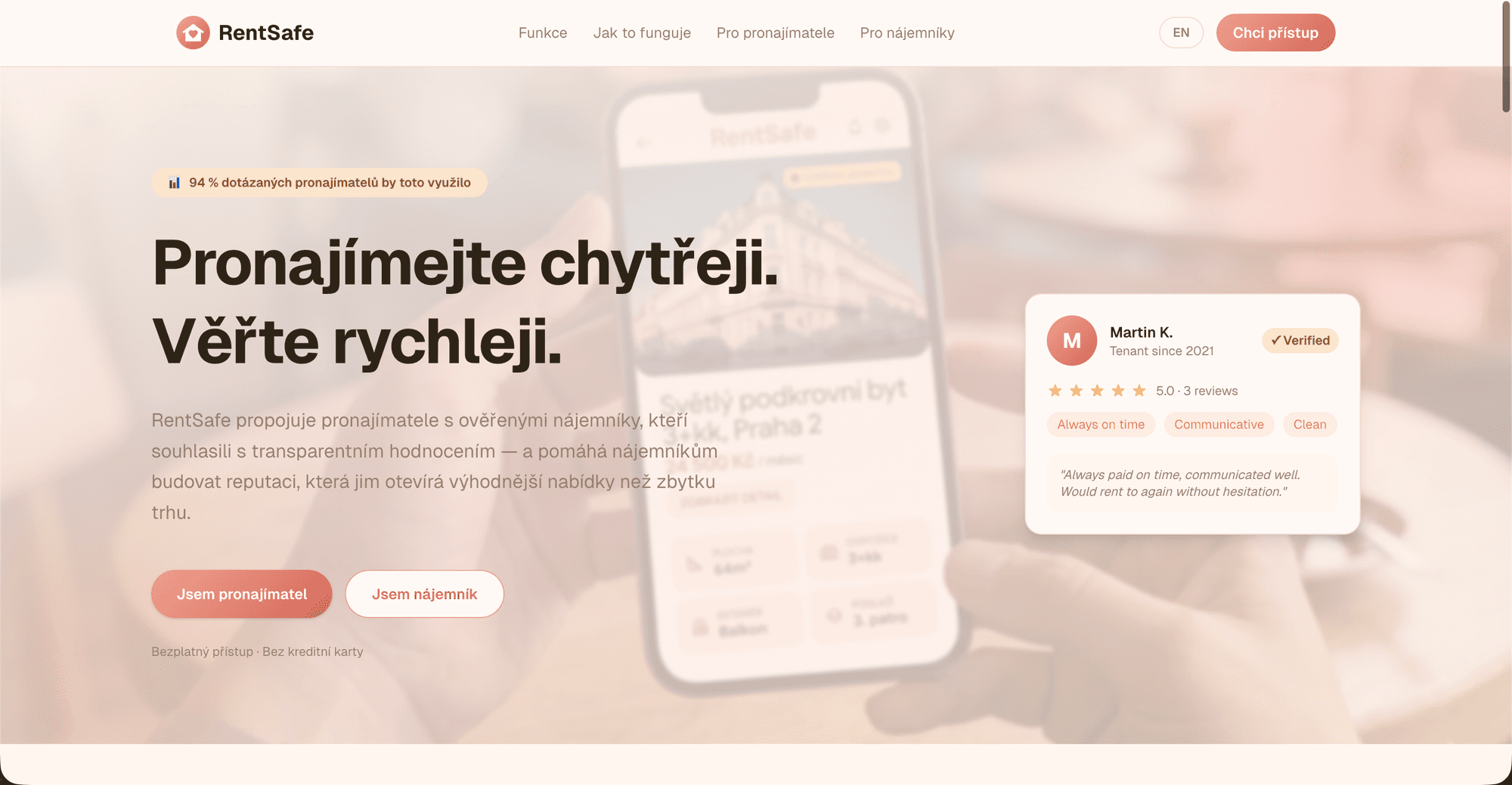
Before writing a single line of production code, we built a simple landing page with two sections, one for landlords and one for tenants, sharing one email sign-up form. The success criterion was set in advance: a conversion rate above 5% among cookie-consenting visitors, a conservative bar relative to the 6.6% industry average for unknown products with no established brand.
We supplemented organic reach (our own social profiles, relevant Facebook groups, direct outreach to survey respondents) with a small paid campaign on Meta Business Suite with a budget of roughly 2,687 CZK. The campaign generated 716 clicks at a 2.19% click-through rate, roughly double the industry average for the real estate category. The cost per click of about 3.75 CZK put it among the more cost-effective results we could have hoped for. Among tracked visitors who had consented to cookies, the conversion rate reached 9.88%, above the target.
We didn't take that result as unambiguous confirmation, though. The absolute number of sign-ups was low, and session-recording data (Microsoft Clarity) revealed that fewer than half of visitors ever scrolled far enough to reach the sign-up form, because it sat too far down the page. That's exactly the kind of insight a raw conversion rate can't give you. Without behavioural data, you can't tell whether low interest is about the product or just a poorly designed page.
Step 5: a clickable prototype tested with ten people
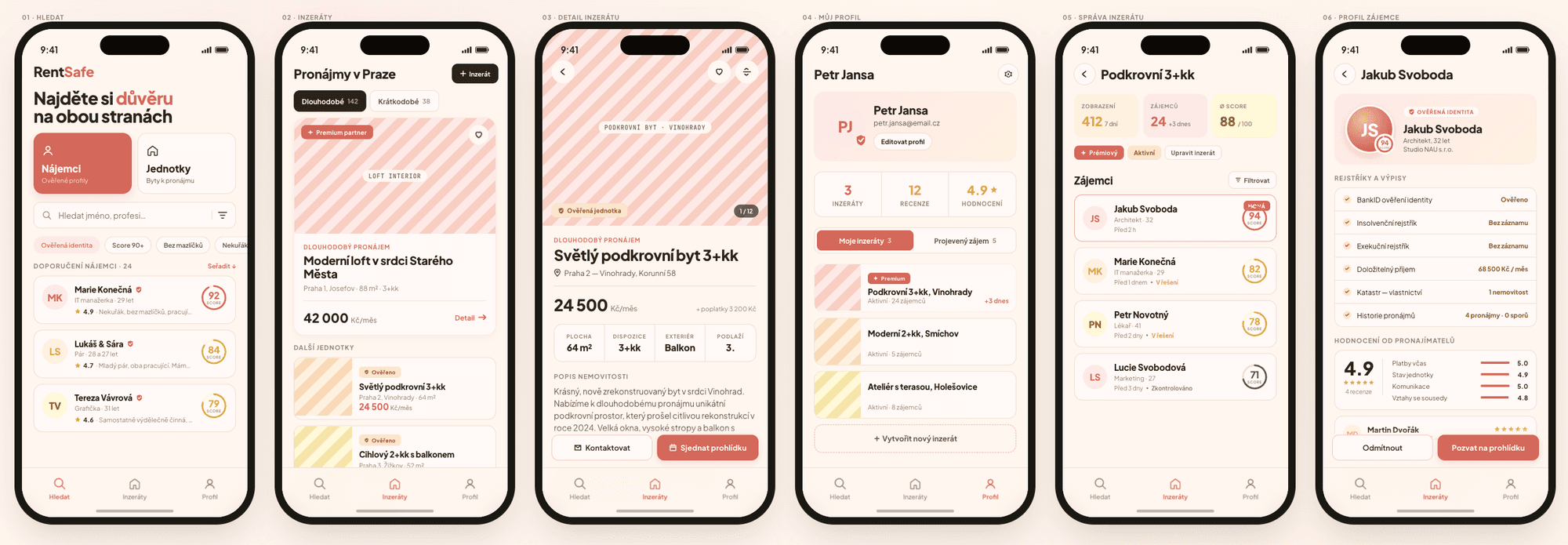
Once basic interest was confirmed, we built a clickable prototype and tested it with ten respondents (five landlords, five prospective tenants) across two rounds using a think-aloud protocol. Five respondents per segment follows Jakob Nielsen's finding that five users uncover most of the significant usability problems within a single user segment.
In the first round we identified four critical issues, such as confusingly labelled tabs in the user profile, that recurred across three or more respondents. After fixing them, all four remaining respondents in the second round completed every assigned task without any help. Asked at the end whether they would use the application, every participant across both rounds said yes.
What to take from this
The whole process, from the first survey to a tested clickable prototype, ran without a single hour spent writing production code. By the time we had to decide whether and how to keep building, we had real numbers on market interest, specific risks named by people who actually deal with the problem, and a tested interface design. This is the same process, scaled to fit the size of the project, that we run for our own clients, whether the deliverable is an internal system, an AI assistant, or process automation. The scope changes with the size of the project. The principle stays the same: validate first, build second.
Sources
- Blank, S. (2013). The Four Steps to the Epiphany: Successful Strategies for Products That Win (2nd ed.). K. & S. Ranch.
- Bland, D. J., & Osterwalder, A. (2019). Testing Business Ideas: A Field Guide for Rapid Experimentation. Wiley.
- Ries, E. (2011). The Lean Startup: How Today's Entrepreneurs Use Continuous Innovation to Create Radically Successful Businesses. Crown Business.
- Fitzpatrick, R. (2013). The Mom Test: How to Talk to Customers and Learn if Your Business Is a Good Idea When Everyone Is Lying to You. Robfitz.
- Nielsen, J. (1994). Usability Engineering. Academic Press.
- Park, P. (2025). What is the average landing page conversion rate? (Q4 2024 data). Retrieved from unbounce.com.
- WordStream. (2025). Facebook Ad Benchmarks for YOUR Industry. Retrieved from wordstream.com.
- Opt Out Advertising. (2025). Audience Whitepaper: Cookie Consent Rates and User Behaviour. Retrieved from optoutadvertising.com.
- Škoda, P. (2026). Validace zákaznického zájmu u digitálního produktu [Bachelor's thesis, source of all figures and findings cited in this article]. Prague University of Economics and Business.