Put your own data to workand answers arrive fast
Company AI, IoT, digital twins and internal systems. Only where it genuinely pays off.

What I build for businesses
At the centre of everything sits the data you already have, or soon will. To get the most out of it, I build internal tools on top of it, and an AI of your own.
And an interface people will actually use
Custom software is worthless when employees work around it. Adoption is decided above all by the interface. So we start with the design, and only then start building.
Let's find out what pays off for you
Thirty minutes on what you are dealing with. I will tell you straight away whether I can do it and whether it is worth the investment.
Book an intro callFree, no strings attached.
Pricing and process
The development quote follows from an audit done up front and is broken into stages. No hidden items and no numbers pulled out of thin air.
How I price work
How we work together
Included in every project
Who am I
My name is Petr Škoda and I build companies internal software, an AI of their own and digital twins of their operations. I hold a bachelor's degree in Applied Informatics and I'm currently pursuing a master's in Business Informatics at VŠE – Prague University of Economics and Business, so I look at both sides: what the technology can do, and whether it pays off for the business.
On every solution I put the emphasis on control over data, measurable benefit and life after go-live.
Who I have worked for
From sole traders and small companies to large multinationals. I grew up in the family business Škoda Milan s.r.o., so running a company is somewhat in my blood and I understand what usually separates a software supplier from the business itself. A system has to fit the people who will use it every day.
What I studied
I studied Information Technology at the Secondary Technical School in Písek, then completed a bachelor of Applied Informatics at the Prague University of Economics and Business. I am now continuing with a master in Business Informatics. The combination of technical and economic training means I can pinpoint where an IT solution genuinely helps and where it is unnecessary.
How I work
I make a point of the client understanding what is being built and why. I explain the consequences of each decision, show work in progress, and say so when building something is not worth it and adjusting a process would do. I do the development myself; for graphics, motion design and extra capacity I work with partners I have used for years. You have one point of contact and the responsibility stays with me.
Where I work
I am based in Prague and in Tálín near Písek in South Bohemia. We can meet in person in either region; otherwise I work remotely with clients across the Czech Republic and abroad.
Certificates


Technologies I work with
Does that approach make sense to you?
Tell me what you are dealing with. The intro call is free and without obligation.
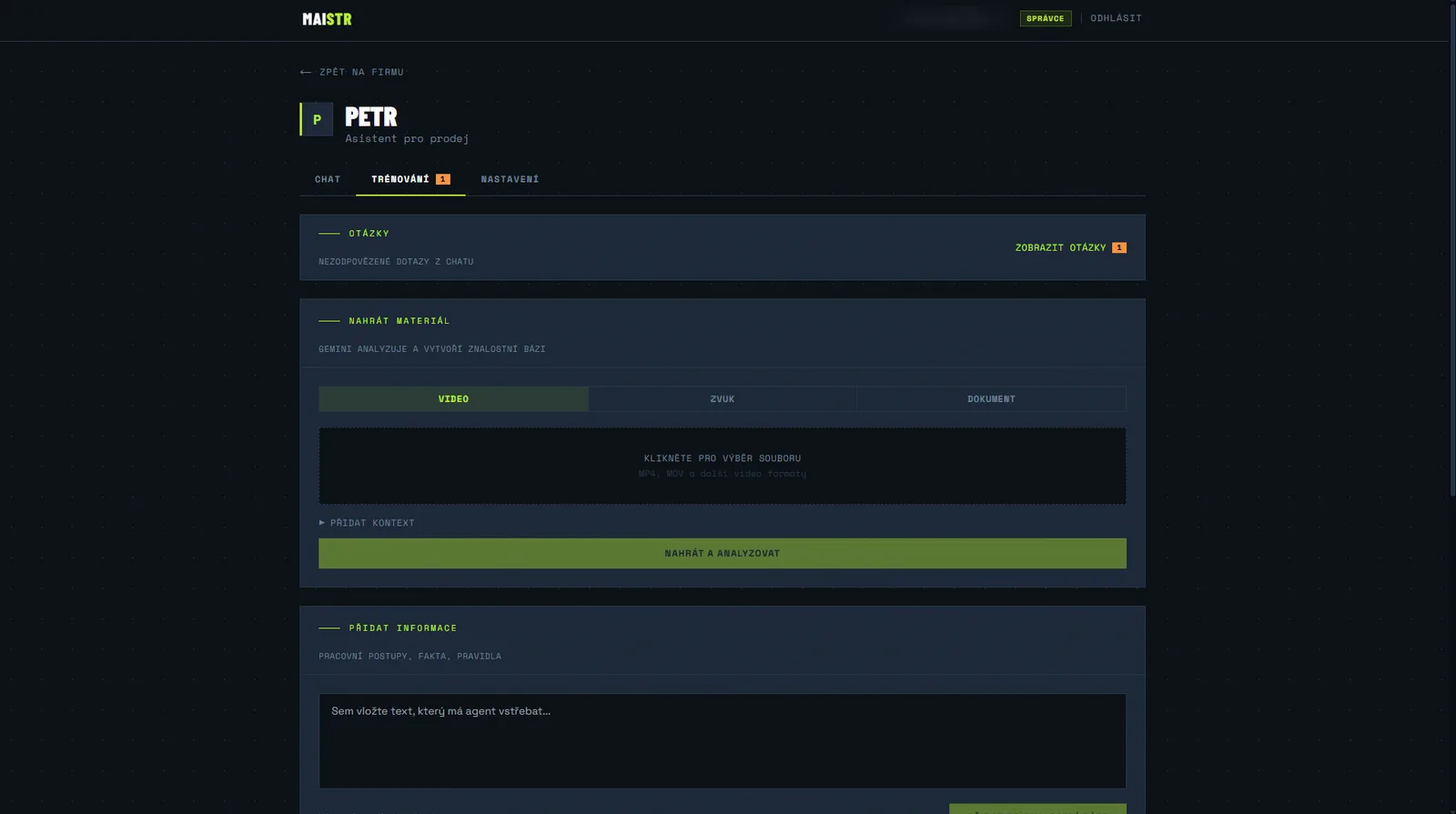
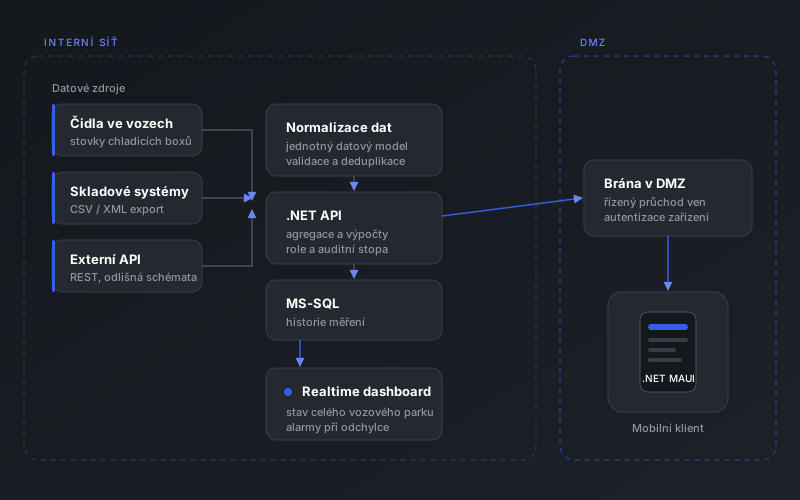
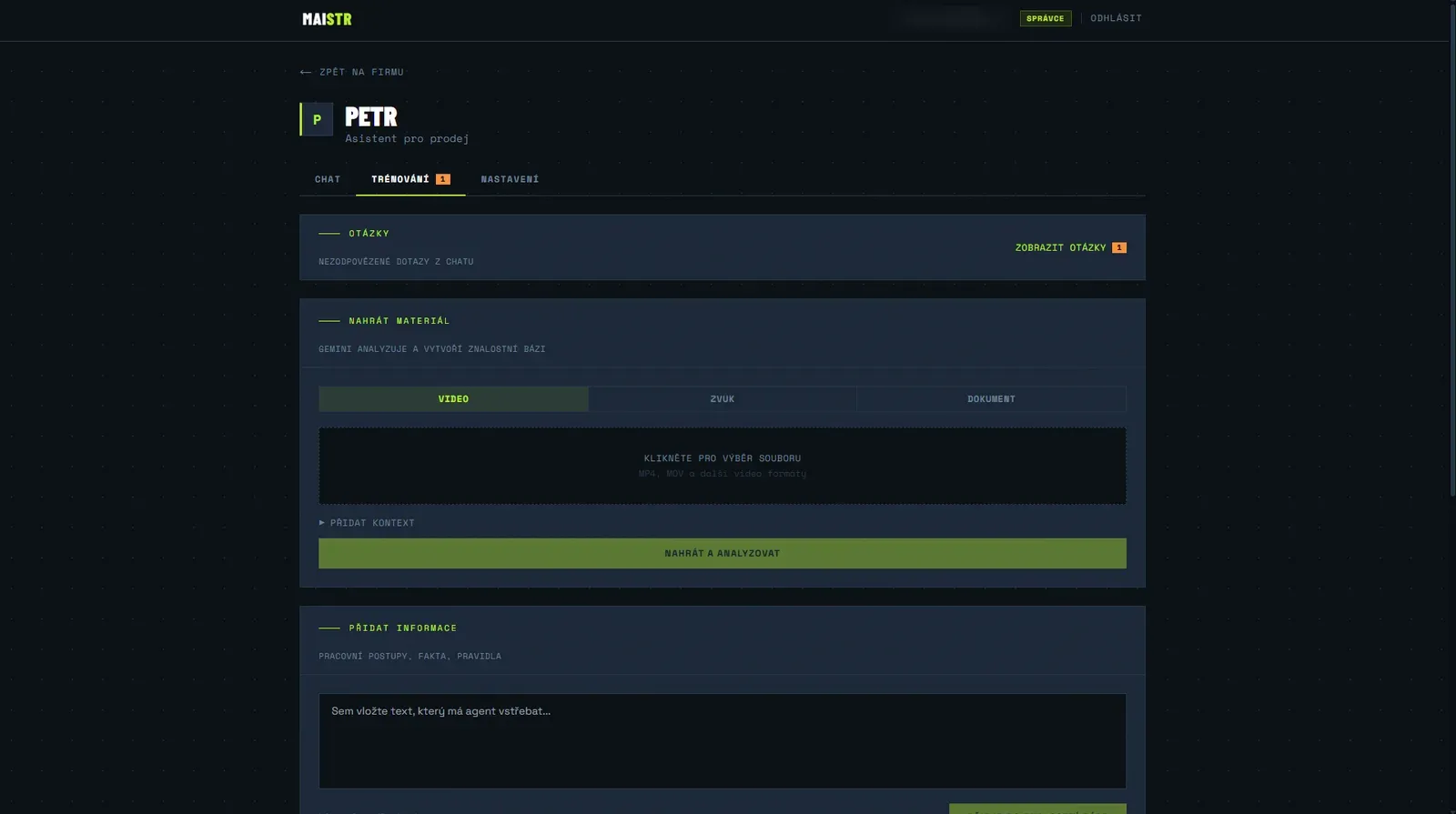
I know this works. And here is the proof.
From the brief and the architecture through to results, including the hard parts


Facing something similar?
Every engagement starts with a short call about goals and constraints. Get in touch.
News from the world of IT
What is shifting in development, cloud and the tooling around them. Short and to the point.

Frequently asked questions
What companies weighing up custom software or AI ask most often
01Do you build ordinary business software, or only AI?
Most of the work is ordinary software: internal systems, data processing, process automation and connecting to what already runs in the company. I add AI where it has something to do, and I say so when the brief does not need it.
02Can you connect to our existing systems?
Yes, that is usually the heart of the job. I regularly integrate ERP, accounting and warehouse systems, SharePoint and DMS, Active Directory and SSO, and third-party APIs. Where no API exists, I design a safe way to get the data out without touching a system that works.
03Where will our data live?
The application and its database can run in your own cloud tenant or on-premise, so documents and operational data stay with you. Where a language model is part of the solution, I call it through a commercial API (OpenAI, Anthropic, Google) in a mode where the provider does not use your content for training and does not retain it beyond serving the request, with EU regions and a data processing agreement. If the data must never leave your perimeter, we can talk about hosting a model of your own.
04Where does the data for a digital twin come from?
From sensors, PLCs and machines, or from the databases of systems you already run. I collect and normalise it into one place, which then feeds the visualisation, the history and the trends. Where a measurement is missing entirely, we add sensors only where the picture makes no sense without them.
05How do you stop the AI from making things up?
Answers are grounded in specific passages from your documents and each one shows its source, so anyone can verify it in two clicks. When there is no supporting material, the assistant says so instead of inventing something. Before go-live we run a set of real questions from your company and score the accuracy with numbers, not impressions.
06Do you only use commercial APIs, or can you build your own model?
In most cases I call commercial APIs from OpenAI, Anthropic or Google. It is the fastest and cheapest route and it is enough for most companies. Where the brief demands it, I can host an open-source model such as Llama on your own or on dedicated infrastructure, and build a custom ML model or neural network. It is not the default: an own model means data to train on, hardware to run it and someone to keep it current. Whether it pays off in your case, I will say up front.
07What does it cost to run each month?
For internal systems it is usually just hosting and the database. An AI solution adds model usage on top, based on the number and size of queries. You get a concrete estimate for your volume as part of the audit, before anything is built. Once live, I track and report costs so they do not creep up unnoticed.
08Who owns the source code and the data?
You do. Source code, documentation, infrastructure access and the processed knowledge base are handed over on completion. I do not work with vendor lock-in; your internal team or another supplier can take the project over at any point. I design solutions so that even the model can be replaced, because the best one today will not be the best one in a year.
09How do you handle NDAs, GDPR and our IT department?
I sign NDAs as standard, respect internal security policies and handle personal data in line with GDPR, including a processing agreement with the model provider where AI is involved. I work with your IT on deployment, access and operating rules, and I will supply whatever your security review needs from a supplier.
10What if it turns out this is not worth it for us?
Then I will say so. That is exactly why we start with an audit rather than development. Sometimes changing a process or buying a module for a system you already own is cheaper and faster. Delivering something nobody uses six months later is a worse reference than a lost contract.
11How long until we see the first result?
The audit takes days. A first pilot in real operation usually four to eight weeks from signing, depending on the state of your data.