About the project
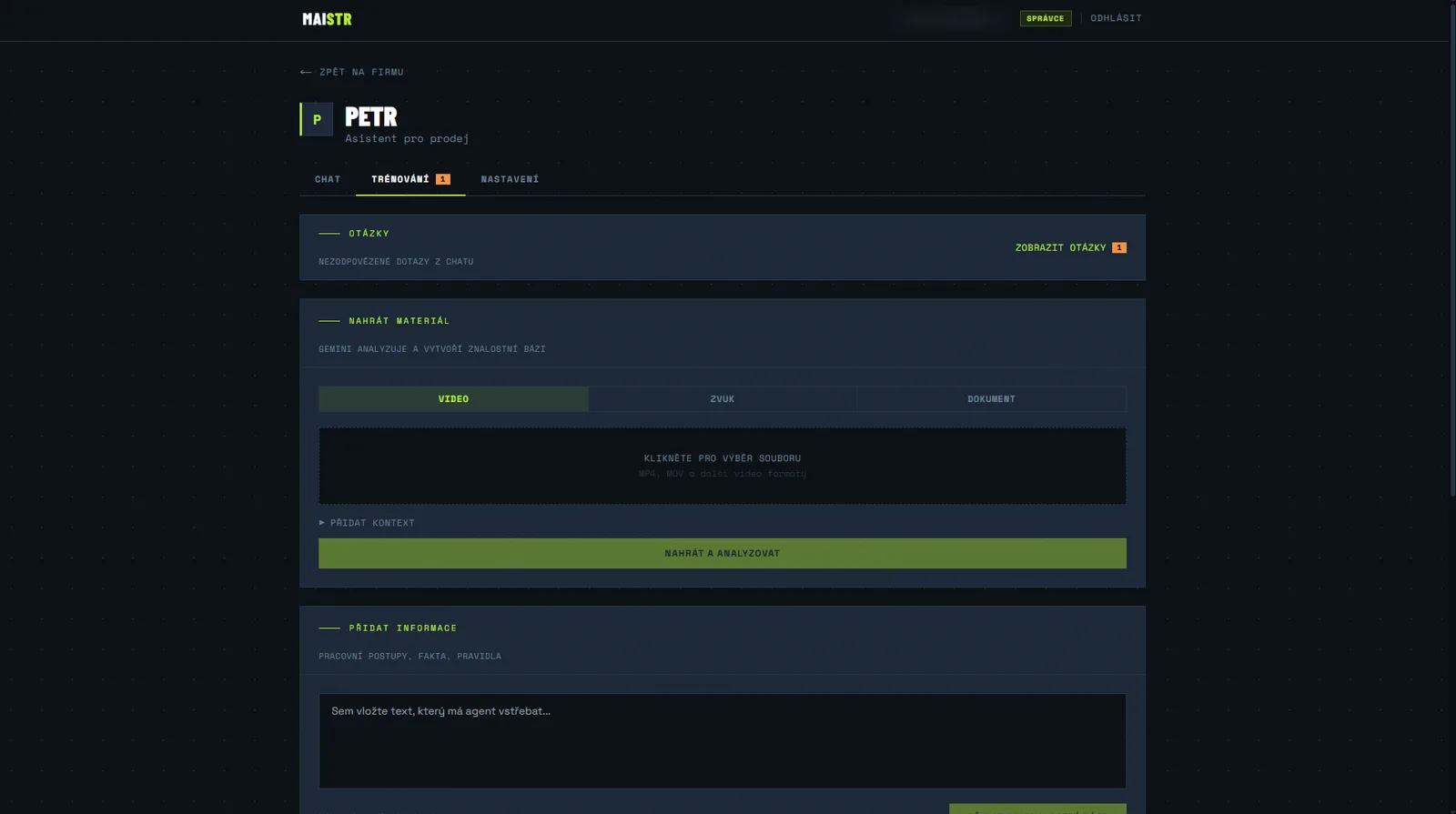
MAIstr came out of a real problem in our family business. The knowledge of experienced people lives in their heads, in notes and in email, and when someone leaves, how things are done leaves with them. MAIstr lets know-how be captured four ways: upload a document, record it by voice, film a video, or simply type it. The AI processes the input, extracts what matters and stores not just the information itself but the relationships between it and what is already in the system. That is what makes the answers accurate and relevant rather than merely similar to the question. An employee then asks in plain language and gets an answer immediately, at any hour. Data security is treated as a priority, because what goes into the system is the most valuable thing a company has. The project also includes the maistr.cz website, built on Next.js and Tailwind. It is not there just to describe the product but to demonstrate it: the MAIstr assistant runs on the page, connected to a knowledge base about the product, so visitors try the feature instead of reading about it. Behaviour on the site is measured with Google Analytics and Microsoft Clarity, and wherever people hesitate we adjust both the site and the onboarding into the app. The project is developed under my own name and is in a pilot phase, taking on its first customers.
Project information
- Client
- Own product
- Platform
- Web application
- Status
- In development
- Development time
- Ongoing, pilot phase
- Year
- 2026
Technologies used
Check out the stack I used for this project
- Frontend
- ReactViteNext.jsTailwind CSS
- Backend
- PythonGeminiClaude
- Database
- QdrantPostgreSQL
- Tools
- Google AnalyticsMicrosoft Clarity
Key features
Knowledge captured four ways: document, voice, video, text
Inputs processed by AI into a knowledge base automatically
Relationships between pieces of information preserved, not isolated snippets
Questions in plain language, answers immediately and at any hour
Specialised agents for individual areas of the business
Overview of unanswered questions as a prompt to fill knowledge gaps
Vector search across the knowledge base
Next.js marketing site with the MAIstr assistant running live on it
Visitor behaviour measured with Google Analytics and Microsoft Clarity
Challenges
- 01
Knowledge is scattered across the company and often exists only in people's heads
- 02
Capturing know-how without costing an experienced person hours of writing
- 03
Similarity search returns fragments without context
- 04
The most valuable company data goes in, so security cannot be an afterthought
- 05
Explaining the value of an AI product to a website visitor in seconds
- 06
Combining several models and data stores into one working whole
Solutions
- 01
Four input routes including voice and video: describing a procedure out loud is enough
- 02
AI processes, sorts and prepares the input into the knowledge base on its own
- 03
Relationships between pieces of information are stored, so answers keep their context
- 04
Data security designed in as a product priority from the start
- 05
The site demonstrates rather than describes: a RAG assistant over MAIstr's own knowledge is there to try
- 06
Qdrant for vector search and PostgreSQL for structured data
Results
Know-how stays with the company even after an experienced employee leaves
Onboarding a new person relies on answers instead of hunting through documents
Answers hold context across sources rather than matching text
Visitors try RAG for themselves before speaking to anyone
The product is running a pilot with its first customers
Development timeline
From analysis to deployment - how the project evolved
ongoing
Validating the problem
Problem identified in the family business, then interviews confirming other companies face it too
iterative
Knowledge base prototype
AI processing of inputs, design of relationship storage, vector search in Qdrant
iterative
Application and agents
React and Vite interface, Python backend, specialised agents and training workflow
iterative
Website and product launch
Next.js and Tailwind marketing site with its own RAG assistant, measured with Google Analytics and Clarity
current
Pilot operation
Taking on first customers, feedback from real usage and reprioritising accordingly
Have a similar project?
I'll be happy to help you build your application. Feel free to contact me for a free consultation.