The machine tells you a failure is coming. Not that it already stopped.
Temperature, vibration, pressure, consumption, flow, a camera feed. The data exists on your shop floor, but nobody collects it, so you hear about the problem from a customer or from the service crew. I build the whole path from sensor to alert: collection, normalisation, a dashboard and a notification while the drift can still be dealt with.
Why choose me?
What you get out of working together, beyond a working solution
Sensor to alert in one layer
Collection from sensors, format normalisation, stored history, evaluation and notification. One solution instead of five tools from five vendors, with data falling through the gaps and nobody sure whose fault it is.
A camera is just another sensor
Where a physical sensor cannot be fitted or would measure nothing, a camera reads the value instead: piece counts, occupancy, a surface defect, the needle position on an old gauge. The output lands in the same dashboard as the rest of the sensor data.
Evaluation runs on your side
The standard deployment is a box on your own network that processes the data on site. Only the result leaves it, a value or an event. That removes the data link you would otherwise pay for, along with most of the questions about where operational data sits.
Predictive maintenance instead of downtime
History shows values drifting apart long before a machine stops. Maintenance then gets planned into a shutdown and into the budget, rather than into peak production and emergency mode.
Different sources, one data model
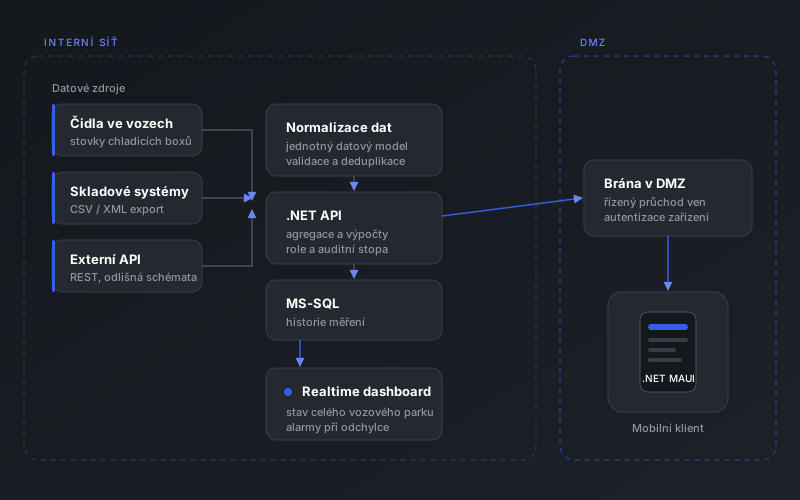
Sensors, PLCs, meters and exports from various systems each come with their own format and their own interval. A normalisation layer turns them into a single model you can query and report on. That is exactly the core of the temperature monitoring system I built for hundreds of refrigerated vehicles.
Alerts where somebody will see them
A message in Teams or email, an SMS for the on-call engineer, a tile in Power BI, a write into ERP or MES, a stack light on the line. An alert that ends up in a log helps nobody.
Types of solutions
Choose the solution that best fits your needs
Environment and chain monitoring
Temperature, humidity and a history you can show an auditor.
- Temperature and humidity in warehouses, boxes and vehicles
- An alarm when limits are breached at a specific location
- Verifiable measurement history for inspections and audits
- Exports and reports without manual retyping
Machine condition and predictive maintenance
Drift reported before it becomes a breakdown.
- Vibration, temperature, current and pressure as wear indicators
- Trend tracking against the machine's normal running
- Maintenance based on operating hours and real load
- Intervention history per individual asset
Consumption and energy
Where the money leaks without showing up on the invoice.
- Electricity, gas, water and compressed air per area
- Consumption per piece, shift or order
- Spotting leaks and draw outside production hours
- Evidence for deciding on efficiency investments
Camera-based monitoring
Data from places where a sensor would measure nothing.
- Occupancy of a car park, loading bay or rack
- Counts of pieces, pallets and vehicle movements
- Visual quality control on the line
- More detail on the computer vision page
Proof from real projects
Real projects where I solved exactly this
Where to find me and where I work from
I am based in Prague and in Tálín near Písek. Consultations run online or in person. I work with clients across the Czech Republic and abroad.
Prague
Letňany and surroundings
Tálín near Písek
South Bohemia
Online
Czech Republic and worldwide
Frequently asked questions
Answers to the questions clients ask most often
01Our machines are old and have no connectivity. Can anything be done?
Usually yes, and it is the most common starting point. The machine itself often needs no modification: an external sensor gets added, a PLC output is read, current draw is measured at the supply, or a gauge is read by camera. What is realistic on a given machine I can tell from a photo of the nameplate and the cabinet, not on site after signing.
02Does it have to run in the cloud?
It does not, and for a single site it usually should not. The default is a box on your network that collects and evaluates data locally. The cloud earns its place once you want data from several sites together, or need access from outside.
03Is this AI, or just threshold values?
Both, in that order. Most of the practical value comes from thresholds and rules, because a temperature over its limit is a simple thing that nobody currently sees. AI and anomaly detection come in where several values interact over time and a fixed threshold would either scream constantly or never fire. I will not sell you a model where a condition does the job.
04How much data does predictive maintenance need?
Months of normal operation, and above all a few recorded failures, because the model needs something to learn from. That is why the first step is collection and alerts on clear deviations, not prediction. Those pay off immediately, and meanwhile the history that prediction needs is being built. Anyone promising predictive maintenance from day one is selling a picture.
05Who supplies the hardware, and what does it cost?
Sensors, gateways and industrial PCs I either supply or recommend, depending on what needs measuring. It is a one-off item, typically in the low thousands of euros per site. Software and integration are the project part; running costs stay low because evaluation happens on your side. Actual figures come in the quote after the audit, not as a guess over the phone.
06Will you connect it to our ERP or MES?
Yes, and it is usually the most valuable part of the project. A measurement on its own is just a chart. Once the value is written against an order, a machine or a shift in ERP or MES, you can actually manage by it. The connection runs through an API, a database or an agreed data exchange.
07What if a sensor stops reporting?
Silence is a state too, and it is reported like any breached limit. The system watches that every source sends data within its expected interval and raises an alert when it stops. Without that, the quietest part of your operation would look like the most reliable one.
08How long until we see something?
Weeks, for one area or one line. The goal of the first step is not a finished platform but measured data and a working alert in one place, where you can check that the numbers make sense to you. Extending to further areas is then a repeat of a proven procedure.
Want to know what your operation could start telling you?
Tell me what you would like to see on the shop floor and what you currently find out too late. On a free intro call we will go through how it can be measured and what the first area would involve. Online or in person in Prague and South Bohemia.
Currently capacity for 2 new projects. We start with an audit, not development.
Before I build anything, we go through your processes and I write up where AI pays off, how much it saves and what running it will cost. The audit fee is deducted from the project that follows.
Or go back to the contact form