 Petr Skoda
The family business behind MAistr, along with plenty of other companies, kept running into the same problem. Key knowledge lives in the heads of experienced employees and master craftsmen, and when they are not around or leave the company, that know-how leaves with them. Junior employees end up asking colleagues, waiting until someone has time, or guessing the correct procedure themselves. MAistr grew directly out of that experience.
What MAistr does
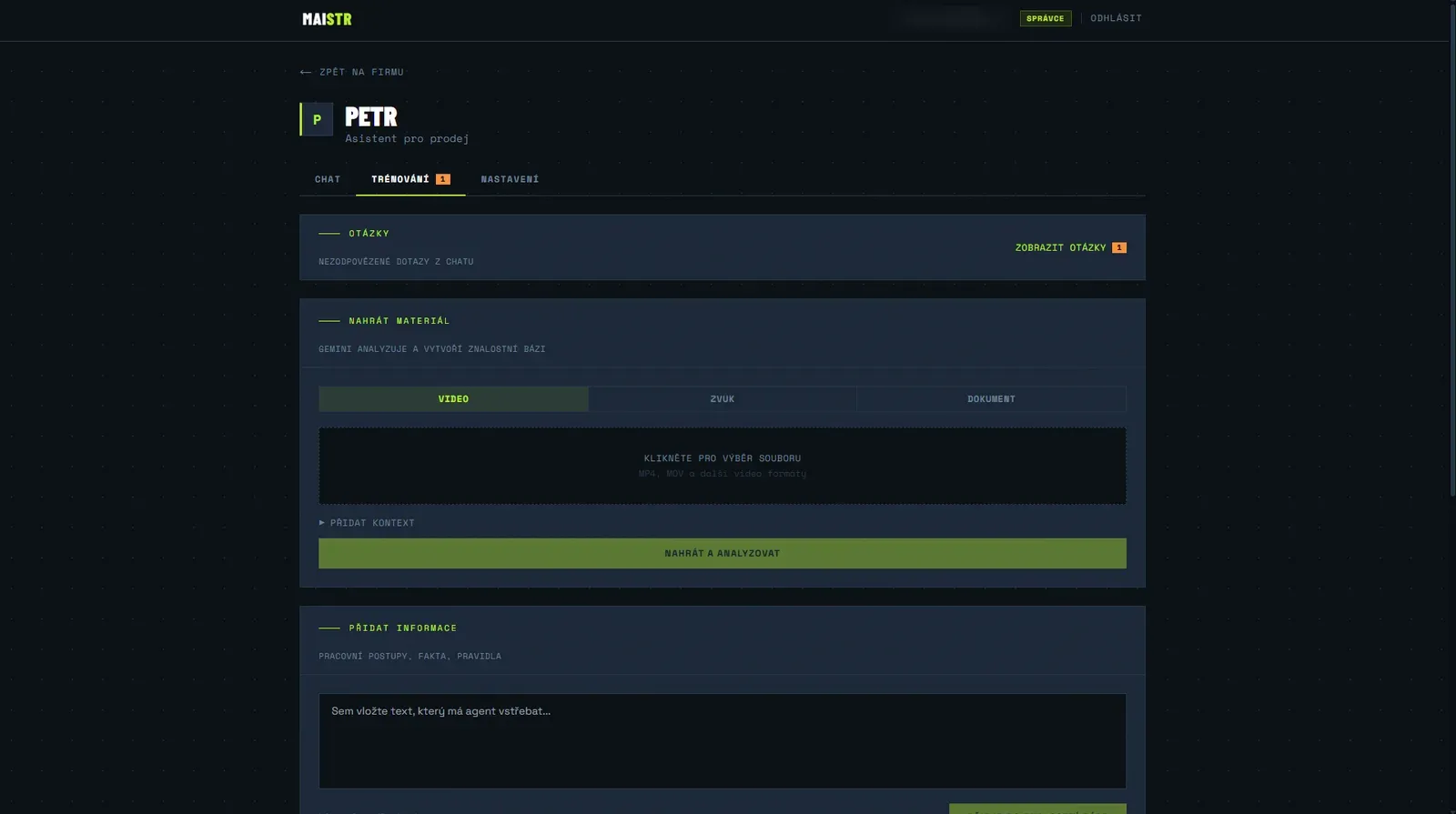
MAistr is an application that stores employee knowledge as video, audio, and text, and turns it into an assistant anyone can ask at any time. Instead of asking a more experienced colleague, an employee asks MAistr, which knows the answers based on what the company has fed into it. The goal is for a master's know-how to stay available even when that master is not on site, is on vacation, or no longer works at the company.
How it works under the hood
Uploaded content, whether it is a video from the shop floor, a voice note, or a written procedure, gets processed and stored in the Qdrant vector database. Audio and video are analyzed using Google's commercial API, specifically the Gemini model, which can process the content of audiovisual recordings. Generating clear, readable text answers relies on Anthropic's commercial API, specifically the Claude model. The whole system runs on the RAG principle, the same approach described in our separate article on searching over company data: the relevant parts of stored knowledge get found in the vector database first, and only then get sent to the model that assembles them into an answer.
The backend runs on Python using the FastAPI framework, which is well suited for working with AI models and asynchronous processing. Backend hosting runs on Railway, the frontend runs on Vercel, and the whole development flow is connected through a CI/CD pipeline from GitHub, so a new version of the application reaches production automatically once it is approved.
Why this architecture is built to grow
Combining commercial APIs for each specific task, separating the frontend from the backend, and automating deployment means the application can grow as more companies and users join, without needing to change the underlying architecture. Gemini and Claude each handle their own specialty, Qdrant keeps knowledge in a form that can be searched quickly and accurately, and the FastAPI backend coordinates the flow of data between them.
Where Eniware fits in
MAistr is an example of how Eniware builds its own AI products from the ground up, from architecture design through model selection to deployment and scaling. The same approach, combining RAG, a vector database, and modern APIs, can be applied to another company's knowledge base too, not only the one where MAistr originated.